Tomato growers usually face a simple-looking choice that has real consequences in the bed, the container, and the kitchen. The determinate vs indeterminate tomato decision affects plant size, pruning, staking, harvest timing, and how much fruit you can process at once. I break down the differences here in practical terms so you can pick the right type for fresh eating, sauce, or a small garden without guessing.
The two tomato habits that drive every other decision
- Determinate tomatoes stop growing at a set height and put most of their energy into a concentrated harvest.
- Indeterminate tomatoes keep growing and fruiting until frost, so they need more support and more season-long attention.
- Compact plants are usually easier to manage in containers and small spaces, but they give you a shorter picking window.
- Vining types are the better fit when you want tomatoes over a longer stretch of summer.
- Pruning and staking are not interchangeable; the wrong approach can reduce yield or make the plant harder to manage.
- Reading the plant tag matters more than guessing from the variety name alone.
What these growth habits actually mean
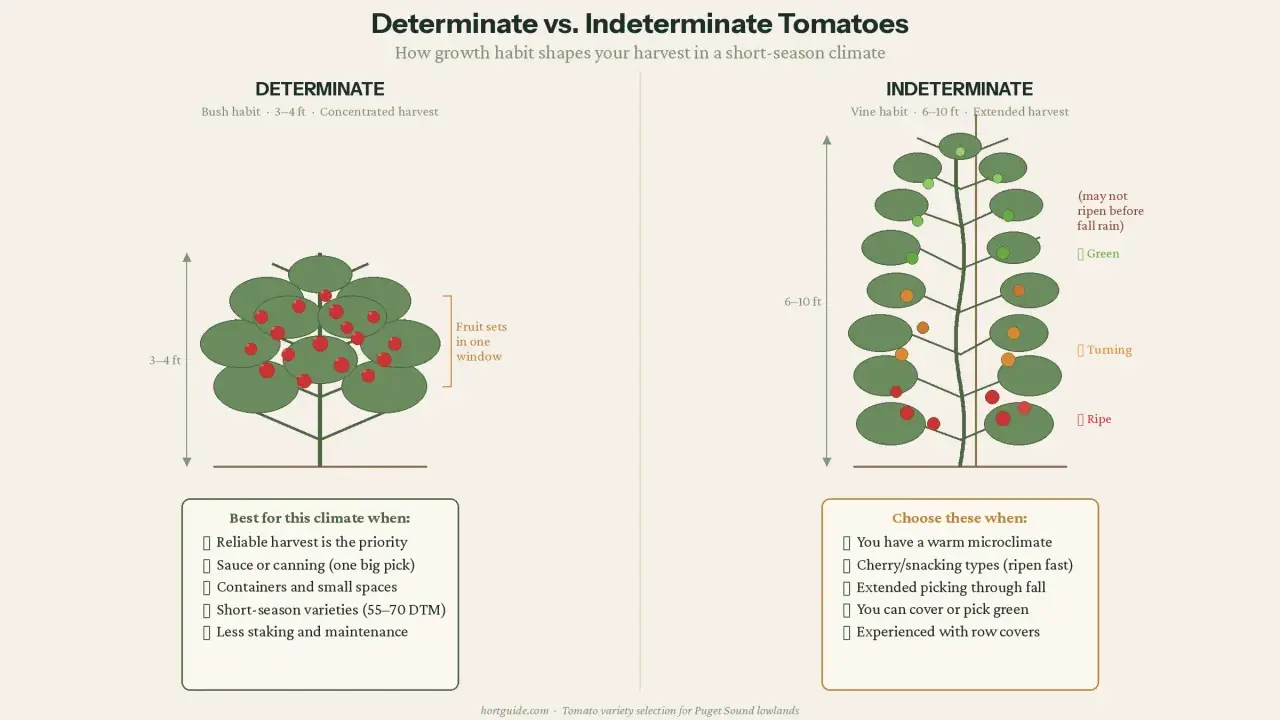
Tomato growth habit is about how the plant finishes its own growth cycle. A determinate plant grows to a certain height, sets a terminal flower cluster, and then shifts most of its energy into ripening fruit. In practice, that means a shorter plant, a more compact shape, and a harvest that tends to come in a tight window. I think of it as a batch crop: productive, concentrated, and easier to schedule around.
Indeterminate tomatoes behave differently. They keep lengthening, flowering, and setting new fruit clusters until cold weather stops them. That is why they often end up 5 to 8 feet tall or more, while determinate plants are commonly closer to 1 to 5 feet. The payoff is a longer harvest, often stretching for two to three months or until frost. There are also in-between types, such as semi-determinate and dwarf indeterminate tomatoes, which blur the line a bit, but the two main habits still explain most of what a home gardener needs to know.The key point is simple: one type finishes fast, the other keeps going. Once you see that, the rest of the comparison becomes much easier to use in the garden.
The practical differences that matter in a garden
When I compare these plants in real gardens, I care less about labels and more about how they behave under pressure: space, support, harvest timing, and maintenance. Here is the short version.
| Trait | Determinate tomatoes | Indeterminate tomatoes |
|---|---|---|
| Typical size | Usually about 1 to 5 feet tall | Commonly 5 to 8 feet tall or taller |
| Harvest pattern | Fruit ripens in a concentrated span, often a few weeks | Fruit arrives steadily across the season, often until frost |
| Support needs | Can get by with light staking or a sturdy cage | Usually needs stakes, cages, or a trellis |
| Pruning style | Light pruning only | Regular sucker removal and training usually help |
| Best fit | Canning, freezing, compact beds, containers | Fresh eating, long harvests, larger gardens |
| Trade-off | Less season length, but easier to process all at once | More work, but a longer and often heavier total harvest |
There is one mistake I see often: gardeners assume the larger plant always yields more in a way that matters to them. A determinate can be the better plant if your real goal is to make salsa on one weekend, while an indeterminate can be the better plant if you want a bowl of tomatoes every few days for months. Yield is not just volume; it is also timing. That difference is what often decides the winner.
How to choose based on your space and harvest goals
If your space is limited, start there. Compact determinate plants are usually the safer choice for small beds and containers because they are easier to keep upright and less likely to overwhelm the area. A 5-gallon bucket can work for some compact tomatoes, but I would still rather give a plant more soil volume when possible because containers dry out fast in American summer heat. For patios, balconies, and tight raised beds, a determinate or dwarf type is usually the least frustrating path.
If your goal is preserving, determinate tomatoes usually make the most sense. Their fruit tends to ripen together, which is exactly what you want when you are canning sauce, making paste, or freezing a big batch. You do the work once, not in small waves all season. That concentrated harvest also helps if you travel or cannot check plants every day.
If you want to eat tomatoes fresh for as long as possible, indeterminate types are the better fit. They suit gardeners who like to pick a few slicers here, a handful of cherries there, and keep the harvest rolling. In warmer parts of the United States with a long frost-free season, that steady production can be the more rewarding option. In shorter seasons, the decision gets tighter, but the same rule still applies: choose the plant that matches the way you will actually use the fruit.
That practical match matters more than variety hype, which is why the next step is learning how to handle each plant once it is in the ground.
How to prune and support each type without fighting the plant
Support and pruning should follow the plant’s growth habit, not the other way around. Determinate tomatoes usually need less intervention. I still like a cage or stake for protection against wind and fruit weight, but heavy pruning is usually a bad trade. With a determinate plant, the harvest is concentrated, so removing too much foliage can cut into the crop and expose fruit to sunscald. Light cleanup of diseased or crowded lower leaves is enough in most cases.
Indeterminate tomatoes need a firmer plan. Because they keep growing, they can become top-heavy fast, and without support they end up sprawling on the ground. Stakes, cages, and trellises all work if they are sturdy enough to last the season. I prefer to remove suckers early, while they are still small, and tie the main stems regularly as the plant climbs. In a compact garden, I often keep one or two strong stems; in more generous spacing, a few extra stems can work if airflow stays good.
There is a trade-off here that beginners often miss. Pruning indeterminate plants can improve fruit quality, keep the fruit cleaner, and make harvesting easier, but it can also reduce total yield if you overdo it. If you open the plant too aggressively, you may also increase sunscald and blossom-end problems because the fruit is suddenly less shaded and the plant is under more stress. The goal is balance, not severity.
Once that balance is clear, the common mistakes become much easier to avoid.
Where gardeners usually go wrong
I see four mistakes again and again. The first is buying by variety name instead of growth habit. Many gardeners assume all Roma types are determinate or all heirlooms are indeterminate, and that is too simplistic. The variety label should tell you the growth habit directly, and that is the fact you should trust.
The second mistake is using the wrong support. A tall indeterminate tomato stuffed into a short, flimsy cage turns into a mess by midsummer. It bends, breaks, and becomes harder to pick. If the plant will keep growing, the support has to be tall and strong from the start.
The third is overfeeding nitrogen. A lot of leafy growth looks impressive, but it does not guarantee fruit. Excess nitrogen pushes foliage at the expense of flowers and fruit set, which is especially frustrating on a plant you expected to be productive.
The fourth is treating determinate tomatoes like mini-vines. Heavy sucker removal is usually the wrong move there. A determinate plant is designed to build and ripen a crop within a short period, so aggressive pruning can do more harm than good.
When gardeners avoid those four errors, the choice between the two growth habits usually becomes straightforward and much more satisfying to live with.
The easiest way to choose the right tomato before you buy the seed packet
My rule is simple: match the plant to the job. If you want a short, concentrated harvest for canning, freezing, or a busy household that needs a lot of fruit at once, choose determinate tomatoes. If you want a long, rolling harvest of fresh fruit, choose indeterminate tomatoes. If you are working with a container, a narrow raised bed, or a small support system, lean compact. If you have room, strong stakes, and the patience to train a vine, lean indeterminate.
- Choose determinate when you want a batch harvest.
- Choose indeterminate when you want a season-long harvest.
- Choose compact or dwarf types when space is tight.
- Check the label for disease resistance as well as growth habit.
- Treat semi-determinate plants as a middle ground, not a free pass on support.
If I had to reduce the whole decision to one sentence, it would be this: pick the plant whose growth pattern fits your schedule, your space, and the way you like to eat tomatoes. That is the difference that keeps a good tomato season from turning into extra work.