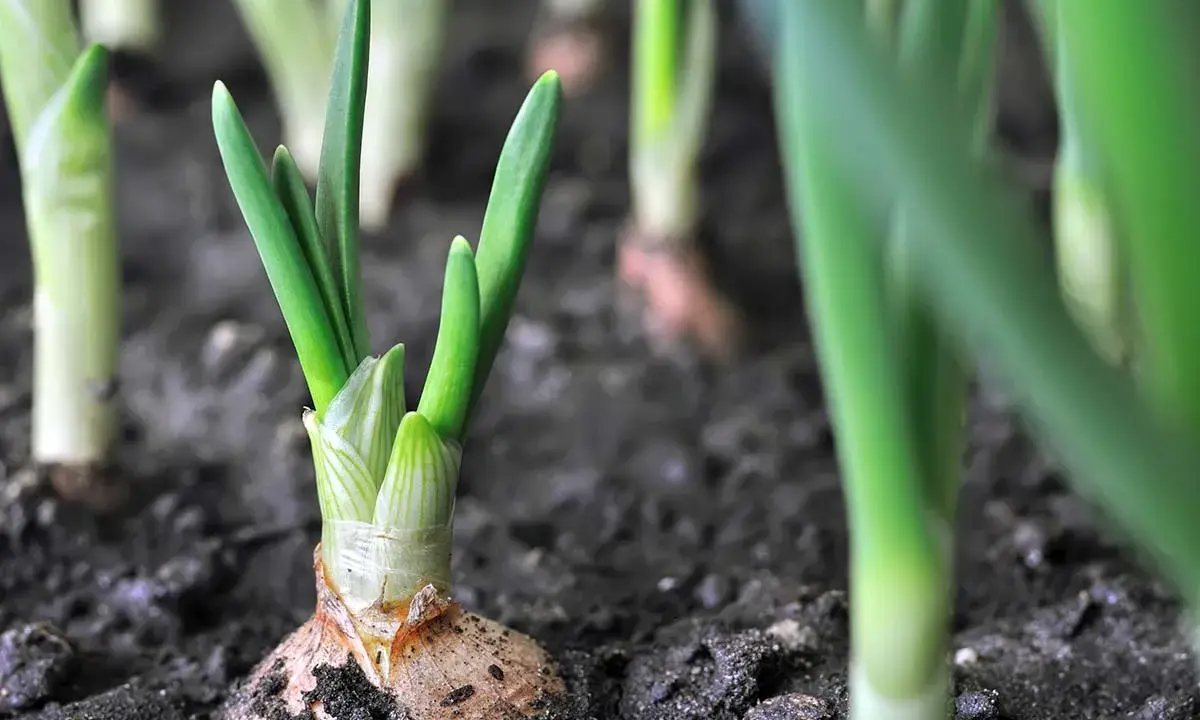
Not every onion is meant to be handled the same way once temperatures drop. Some are best grown as perennial greens, others as fall-planted bulbing crops that keep moving through cool weather and finish early. That is the difference between dependable winter onions and a bed that simply stalls, bolts, or rots.
The right choice depends on your climate, your harvest window, and whether you want greens or bulbs
- Egyptian or walking onions are the most reliable perennial choice for repeated spring harvests.
- Multiplier, or potato, onions can give you both greens and small bulbs, but they are harder to source.
- Japanese bunching onions are the safest option where winter is long and hard.
- Fall-planted bulbing onions can work, but only when day length and planting date match the region.
- Loose soil, steady moisture, and late-season mulch matter more than heavy feeding.
What gardeners usually mean by a cold-hardy onion
Iowa State University Extension uses the term broadly for onions that survive outdoors in the ground, and that is the most useful way to think about it. In practice, I separate them into two groups: perennial types that keep coming back, and bulbing types that are planted for an early harvest the following season. That distinction matters because the planting method, spacing, and harvest window are not the same.
Perennial alliums are the easier place to start if you want a low-maintenance edible patch. Bulbing types ask for better timing and a stronger match between cultivar and latitude. If you know which camp your crop belongs to, the rest of the job gets much easier.
The onion types I would actually consider planting
| Type | Best use | Cold behavior | Planting window | Main tradeoff |
|---|---|---|---|---|
| Egyptian or walking onion | Green onions and a perennial patch | Very hardy and often stays green through winter | Sets in late summer or division in early spring | Not a classic storage bulb |
| Multiplier or potato onion | Greens plus small to medium bulbs | Can overwinter with mulch | Fall planting, then late-season mulching | Harder to find and less standardized than common onions |
| Japanese bunching onion | Reliable spring greens | Very hardy and well suited to overwintering | Seeded in late summer | No true bulb, so it is a greens crop |
| Fall-planted bulbing onion | Early summer bulbs | Can survive winter in the right region and with the right cultivar | Late summer to early fall, depending on local conditions | More sensitive to day length, bolting, and timing errors |
The most dependable perennial option is the walking onion, because it gives you a green harvest with very little replanting. Multiplier onions are more interesting if you want to move beyond the usual supermarket bulb and experiment with a crop that divides into clusters underground. If I were choosing for a first trial, I would start with one perennial bed and one small row of a proven fall-planted bulbing cultivar, not a whole garden bed of untested seed.
How day length decides whether you get bulbs or leaves
Onions do not just react to temperature; they also react to day length. In long-day regions, short-day onions tend to bulb too early and stay small, while long-day onions may make leaves without ever bulbing properly if they are grown under the wrong light pattern. That is why the same variety can be excellent in one state and disappointing in another.
As a rule, short-day onions bulb at about 12 hours of daylight or less, intermediate-day types around 12 to 14 hours, and long-day onions at roughly 14 to 16 hours. In the northern U.S., long-day cultivars are usually the safe bulb crop, while short-day onions belong farther south. Extension recommendations in the Southeast also point to newer intermediate- and long-day cultivars that can overwinter well when fall-planted, which is a useful reminder that breeding has made this category more flexible than it used to be.
The practical lesson is simple: do not buy an onion because the name sounds sweet or the bulb looks pretty. Buy it because its day-length requirement matches your latitude and your harvest goal. That one decision does more to shape the crop than any fertilizer trick.
Planting and mulching so the bed survives the cold
Onions want cool weather, loose soil, and steady moisture. MU Extension notes that they grow best around 55 to 75 degrees Fahrenheit in a friable soil with a pH of about 6.2 to 6.8, and that is a solid target for home gardeners too. I would treat drainage as non-negotiable: wet winter soil does more damage than a few hard freezes.
For perennial types, plant sets about 1 inch deep and space them roughly 4 to 5 inches apart. If you are dividing an existing clump in early spring, replant the divisions at the same basic spacing and keep the bed on the edge of the garden so the perennial patch does not get in the way of rotation. For fall-planted bulbing onions, transplants or sets are usually set shallower, around 3/4 to 1 inch deep, and about 3 inches apart, because overly deep planting can slow establishment.
- Prepare the bed first with compost or well-finished organic matter, then check drainage before you plant.
- Plant while soil is still workable but not hot, so roots can establish before the first hard freeze.
- Keep the bed evenly moist during active growth, but never let it sit soggy.
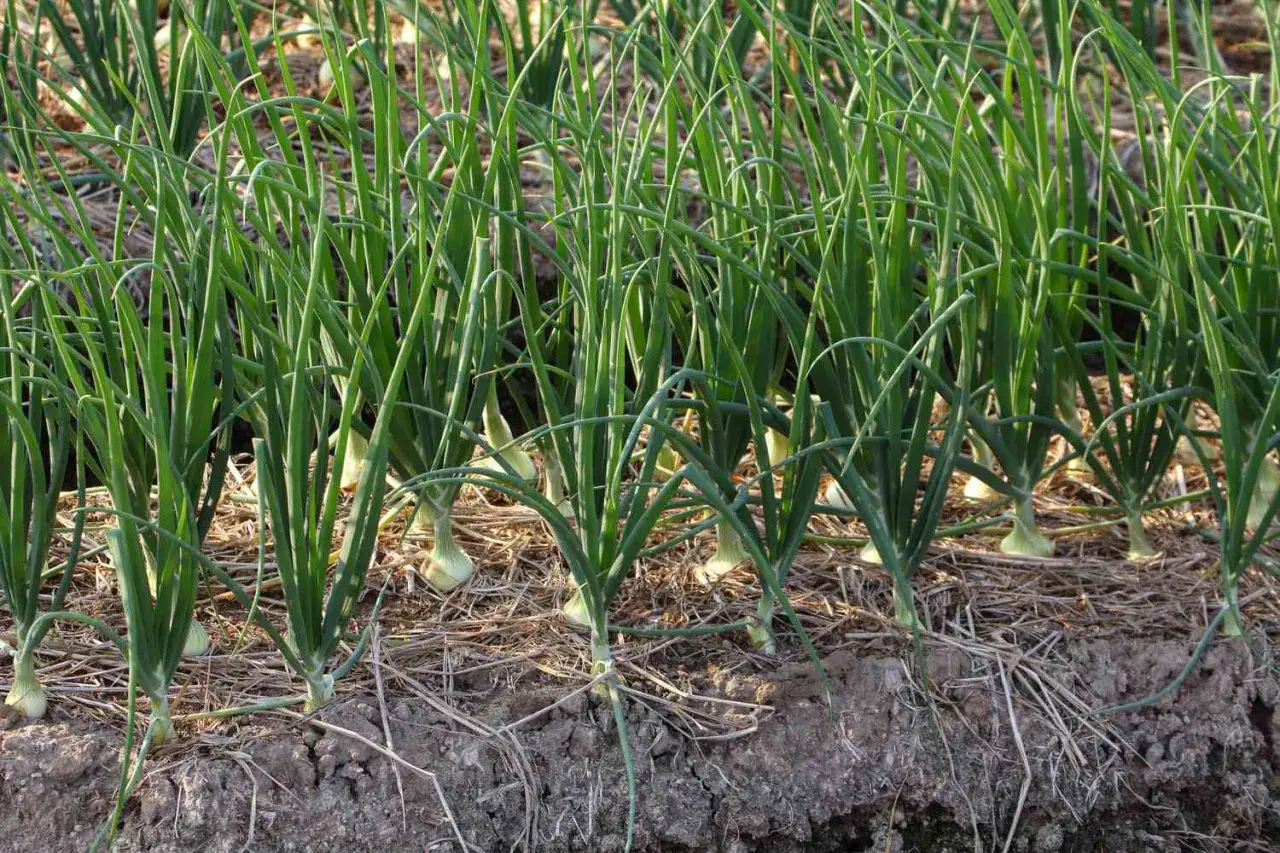
- Add mulch late in the season, after plants are established, to reduce winter heaving and cold injury.
- Control weeds early, because onions are shallow-rooted and poor competitors.
That last point is where many gardeners lose ground. The crop looks tidy when it is young, then a flush of weeds steals moisture and light just as the onions are trying to size up. A thin, clean mulch layer is often more useful than another round of fertilizer.
The mistakes that cost you the crop before spring
The most common mistake is choosing the wrong variety for the region. A long-day onion in a short-day climate, or a short-day onion in a northern garden, can look healthy for weeks and still fail to make a usable bulb. Another frequent problem is planting too early in fall, which can trigger excess top growth and increase the risk of bolting when the weather swings.
Bolting is not just a cosmetic issue. Once a plant sends up a flower stalk, bulb development slows or stops, and the finished onion usually stores poorly. Illinois Extension notes that broken-over tops can stop bulb development and lead to immature, lower-quality bulbs, which is exactly the kind of mistake that makes a crop feel worse than it should.
- Too much nitrogen late in the season pushes leaves instead of bulbs.
- Poor drainage invites rot and weak winter survival.
- Skipping mulch leaves crowns exposed to freeze-thaw damage.
- Letting weeds get established early reduces bulb size later.
- Planting perennial types too deep slows spring regrowth.
If a bed fails, I rarely blame a single factor. Usually it is a chain: wrong cultivar, weak soil preparation, and a planting window that was a little too optimistic. The good news is that onions are forgiving once you give them the right framework, which is why the next harvest step matters just as much as the planting step.
How I would harvest and use them once growth resumes
Perennial onion types are best treated as a fresh green crop first and a bulb crop second. In spring, I would cut what I need from the top growth and leave the plant to keep producing. Walking onions are especially useful for this, because the tops give you an early harvest long before the rest of the garden is ready.
For bulbing onions, harvest when the necks dry down and the tops fall over. That is the sign the bulb has finished sizing up and is ready to cure. After harvest, keep them in a warm, airy place with low humidity until the outer layers dry. Sweet types are usually better eaten sooner, while drier, more pungent onions tend to store longer.
In the kitchen, the crop has a wide range. Young green tops can go into soups, omelets, stir-fries, and potato dishes. Small bulbs are excellent roasted whole, quick-pickled, or sliced raw when they are still crisp. If you grow both perennial greens and a fall-planted bulb row, you can stretch harvest from early spring into midsummer without replanting every few weeks.
The starter plan I would use in a small U.S. garden
If I wanted the simplest possible start, I would build a small perennial bed with walking onions or Japanese bunching onions and place it along the edge of the garden. That gives me a reliable edible patch, a low risk of winter loss, and an early spring harvest that does not depend on perfect timing.
If I wanted bulbs, I would trial one row of a region-appropriate long-day or intermediate-day cultivar before committing more space. I would plant it shallow, keep the soil loose, mulch late, and watch how it behaves through the first cold spell. That one season of observation tells you more than a packet description ever will.
For most home gardeners, the smartest approach is not to force one onion system everywhere. It is to match the plant to the season you actually have, then give it the three things it needs most: the right day length, clean soil structure, and a protected root zone. Do that, and an overwintered onion patch becomes one of the most dependable parts of the edible garden.