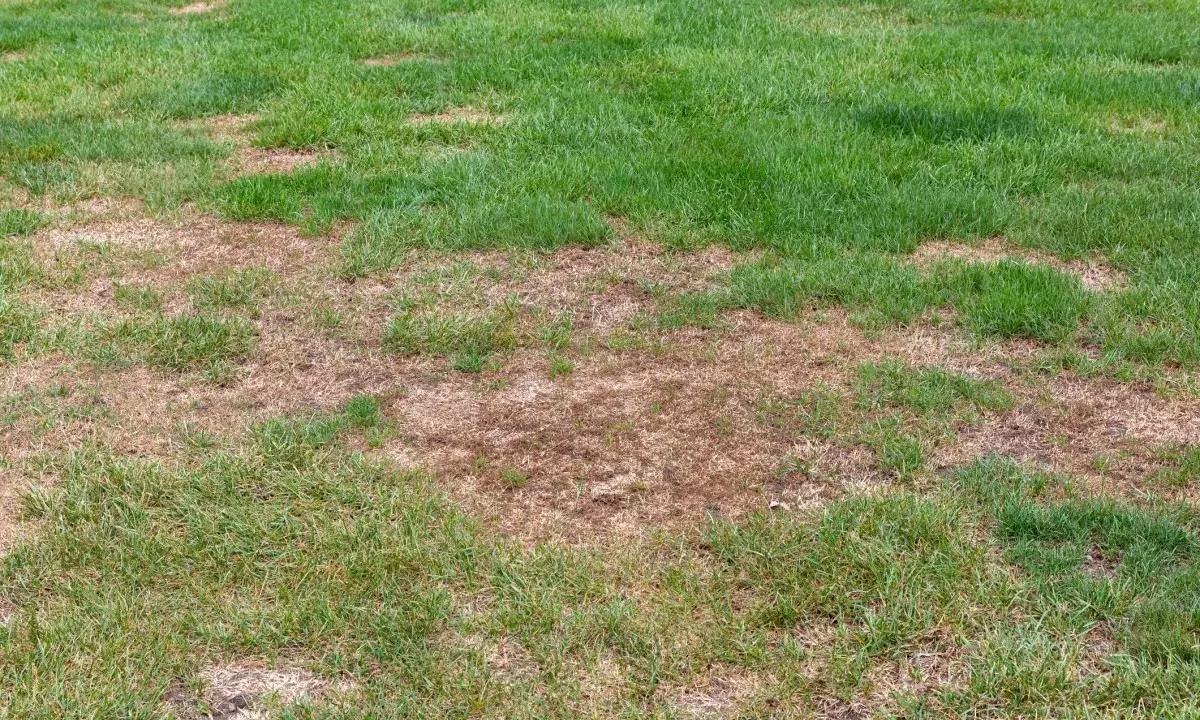
Key points to keep in mind before you treat the lawn
- Grub larvae feed on grass roots, so the first warning is usually wilting, thinning, or turf that lifts too easily.
- A few grubs per square foot can be tolerable in healthy turf; treatment becomes more reasonable when counts rise and the lawn is already stressed.
- Timing matters more than the product name: preventive options work before larvae get large, while curative options are for active infestations.
- Beneficial nematodes can help, but they need moist soil and young larvae to perform well.
- Milky spore is narrow in scope and only targets Japanese beetle grubs, so it is not a universal lawn fix.
What is happening underground when the lawn starts to fail
I think of grub damage as a root problem first and an insect problem second. The larvae of scarab beetles, including Japanese beetles, masked chafers, and June beetles, live in the soil and feed on roots, organic matter, and sometimes thatch. Once enough roots are removed, the grass can no longer move water efficiently, so the turf begins to wilt even when the surface still looks green for a while.
That delay is what makes the problem frustrating. People often water harder, fertilize more, or blame the weather, but the grass is failing because the support system below it is gone. When root loss gets severe, the sod can be rolled back like a rug. That is the point where the lawn is no longer just stressed; it is being eaten from below.
Species matter more than most homeowners realize. Different beetles have different egg-laying habits, and not every grub species causes the same level of turf injury. Once I know the pest biology, I can decide whether the next step is scouting, treatment, or simply helping the lawn recover.
How I confirm that grubs are the real cause
The first clues are usually patchy yellowing, wilting that does not improve after watering, and irregular dead spots that spread outward over time. In damaged lawns, birds, skunks, raccoons, and moles may show up because they are feeding on the larvae or the disturbed soil. Those animals do not cause the original issue, but they can make a bad patch look much worse.
I also look for the classic turf test: if the grass pulls away from the soil with very little resistance, the roots are probably gone. That said, I never diagnose by appearance alone. Drought, compaction, fungal disease, fertilizer burn, and irrigation failure can all mimic grub injury, so I always check the soil.
The simplest check is to cut a small square of turf, about 1 square foot, along the edge where healthy grass meets damaged grass. I lift the sod, break apart the soil in the root zone, and count what is there. The larvae are creamy white, C-shaped, and usually have a tan or brown head with visible legs near the front. If I find them, I keep going in a few nearby spots because infestations are often uneven.
The edge of the damaged area matters because that is usually where active feeding is easiest to see. Once I confirm the pest, the next question is not whether there are grubs at all, but whether there are enough to justify treatment.When the damage is serious enough to treat
There is no universal national threshold that applies to every lawn, every grass type, and every grub species. Healthy turf can tolerate some root loss, while thin, drought-stressed, or newly seeded turf can fail much sooner. That is why I use both the count and the condition of the lawn before making a call.
| Grub count per square foot | What I usually do |
|---|---|
| 1 to 3 | Monitor, improve turf health, and resample if the patch is expanding. |
| 4 to 6 | Watch closely. Treat only if the lawn is already thinning or damage is spreading. |
| 7 to 10+ | Consider treatment, especially if the turf lifts easily and roots are mostly gone. |
That table is a working rule, not a law. I lean more conservative if the lawn is strong and irrigated well, and I lean more aggressive if the turf is weak, newly established, or already under heat stress. The point is to avoid spraying on autopilot. A few larvae do not automatically justify intervention.
Once you know the pest is doing enough damage to matter, the next decision is choosing a control method that matches the stage of the infestation.
Which control methods are worth using
When people ask me what works best, I usually answer with a correction: the best method is the one that matches the timing, the species, and the level of damage already present. There is no single product that fixes every grub problem in every lawn.
| Approach | Best use | Strengths | Limits |
|---|---|---|---|
| Cultural recovery | After the larvae are gone or when numbers are too low for treatment | Helps turf rebound, rebuild roots, and fill bare spots | Does not kill grubs |
| Preventive insecticides | Before eggs hatch or when larvae are still very small | Reliable when timed correctly and often gives the best long-term control | Too late if the lawn is already collapsing |
| Curative insecticides | Active infestations with feeding larvae present | Can reduce an outbreak quickly | Works best on younger grubs and usually has a shorter window |
| Beneficial nematodes | Young larvae in warm, moist soil | Less disruptive to the lawn ecosystem and useful in a softer-IPM plan | Performance depends heavily on application quality and weather |
| Milky spore | Lawns with Japanese beetle pressure | Can be useful in the right situation and is species-specific | Slow, narrow in scope, and not a general grub cure |
If I had to simplify the decision, I would say this: preventive products are for protection, curative products are for cleanup, and biological options are for gardeners who want a less aggressive approach and are willing to respect the timing. Milky spore is the most misunderstood of the group because it sounds like a universal answer, but it is not. It is tied to Japanese beetle grubs, and it is not the right tool for every lawn.
However, even a good product can fail if it is put down at the wrong stage. That is why timing matters more than brute force.
Why timing beats brute force every time
In much of the United States, beetles lay eggs in early to midsummer, and the larvae are easiest to manage while they are still small. I usually think about scouting in mid- to late summer, especially in lawns that have a history of hot spots. By the time the turf is badly brown and birds are tearing it apart, the larvae may already be large enough that the same treatment is less effective.
That timing difference matters. Preventive products are meant to be in the soil before the larvae reach their more destructive stages. Curative products are for active problems, but they still work better when the grubs are young and feeding near the root zone. Beneficial nematodes also perform best when the soil is moist and the larvae are small enough to infect easily.
I also want to stress one practical point: do not treat every year just because your neighborhood had grubs once. If you sampled last season and found no meaningful population this season, a blanket application is often wasted money and unnecessary pressure on the lawn ecosystem. The smarter move is to sample, confirm, and then act.
Once the timing is right, the next job is to make the lawn harder to damage in the first place.
How to keep the lawn from getting hit again
The strongest lawns are not grub-proof, but they are far more forgiving. I focus on root health, not just color, because a dense root system gives the grass a buffer when some feeding occurs. That usually means mowing at the proper height for the grass type, watering deeply but not constantly, and avoiding the kind of shallow, frequent irrigation that keeps the surface soft and vulnerable.
Aeration and overseeding can help after an infestation, especially if the turf has thinned out or the soil is compacted. I also like to repair bare spots in fall rather than leaving open soil exposed through the next beetle cycle. A lawn that recovers quickly is less likely to become a repeat target.Hot spots deserve special attention. If the same border, slope, or sunny section gets hit year after year, I inspect that area first and keep notes on what I find. That habit saves time because grub pressure is often uneven across a property. Good lawn care is partly about observation, not just products.
The goal is not perfection. It is a lawn with enough root strength to absorb a little feeding without collapsing into bare soil.
What I want homeowners to remember after the lawn recovers
Grub trouble is easiest to handle when you treat it like a diagnosis, not a guessing game. I start with the roots, confirm the larvae, count what is there, and then choose the lightest effective response that fits the season and the damage.
If the lawn is already badly torn up, the immediate priority is recovery. If the infestation is still small, prevention may be the better investment. If you are unsure which beetle species is involved, or whether the turf problem is actually from grubs at all, a local extension office or a turf professional can help narrow it down before you spend money on the wrong fix.
What matters most is this: healthy turf, careful scouting, and proper timing usually do more for long-term grub control than repeated emergency treatments.